
OEM manufacturing of commercial dashi and furikake
We will use the experience and technology we have gained from manufacturing commercial-use processed bonito products for over 40 years to create the “dashi” and “furikake” of your dreams.
Introducing our OEM manufacturing factories
Tajiri Factory
Certifications
- Seafood processing facility HACCP certified (dried bonito flakes)
- FSSC22000 certification audit and registration scope (production of dried bonito flakes, crushed dried bonito flakes, dashi packs, and liquid dashi)
- Business license: Fishery product manufacturing
- Overseas facility registration: United States (FDA), China, New Zealand, Russia
- Pet feed manufacturer (dogs/cats)
- Halal certification (thin shaving line, powder line) (certified by the Japan Halal Association)
Introducing the OEM production line at Tajiri Factory
Thin shaving line (total of 3 rooms)
Processing ability
| Possible production volume per day | 800kg to 1,000kg per line |
|---|---|
| Thickness of bonito flakes | 10 microns (0.01 mm) to 300 microns (0.3 mm) |
| Types of dried bonito flakes | Dried bonito flakes, shavings of obi strips, shavings of thread |
| Crushing | 3mm, 6mm, 10mm, 13mm, 25mm, 40mm |
| Grinding | 1mm, 2mm, 2.5mm, 3mm, 5mm |
| Foreign body removal | Magnets, wind-powered sorters (crushing and grinding lines only), metal detectors |
| Main entry points | 5500g, 1kg, 5kg, 10kg (crushed only), 15kg (crushed only) |
Products
| Bonito flakes | Regular bonito flakes. Thin bonito flakes make dashi quickly and have a strong aroma. Main uses: for making dashi, as a topping for okonomiyaki, pet food, etc. |
|---|---|
| Obi shaving | It is shaved with a slitted plane blade. When used as a topping, it has a more three-dimensional appearance than bonito flakes. Main uses: Topping for spinach salad, furikake flakes, etc. |
| Thread shaving | It is shaved with a blade that has even finer slits than the obi shavings. It is often used for “tenmori” (tempura platter) in Japanese cuisine. Main uses: Toppings (salted dishes, vinegared dishes, blanched dishes, pickles, simmered dishes, etc.) |
| crushed products | The dried bonito flakes are crushed into small pieces using a machine called a crusher. The rotating saw-like blades make the pieces smaller. The fineness can be adjusted by changing the mesh setting. Main uses: Takoyaki topping, tsukudani, small pack filling, etc. |
| Crushed products (thin shavings line) | After being crushed in a crusher, it is further crushed by passing it through a machine called a power mill. Main uses: For filling dashi packs, dashi powder, mixing into dry pet food, etc. |
Thick shaving line (1 room)
Processing ability
| Possible production volume per day | 1,500kg to 2,000kg |
|---|---|
| Thickness of bonito flakes | 300 microns (0.3 mm) to 1,000 microns (1 mm) |
| Types of dried bonito flakes | Thick shaving, medium thickness shaving |
| Foreign body removal | Magnets, metal detectors |
| Main entry points | 1kg, 5kg, 10kg |
Products
| Thick shavings | These thickly shaved dried bonito flakes are made specifically for making dashi. Compared to bonito flakes, they require more time to make dashi. The aroma is a little weaker as it dissipates with heat, but they produce a rich dashi with a strong fishy flavor. Main uses: Making dashi (for soba noodles, simmered dishes, oden, and other dishes with strong flavors) |
|---|---|
| Medium thickness shavings | Although there is no clear definition, we call bonito flakes shaved to about 300 to 600 microns “medium-thick shavings.” These shavings allow you to extract broth faster than thick shavings, resulting in a broth with a good balance of aroma and flavor. They can also be used as snacks with a chewy texture. Main uses: making broth, snacks, etc. |
Powder line (1 room)
Processing ability
| Possible production volume per day | 900kg |
|---|---|
| Coarse crushing | 4mm, 6mm, 8mm, 30mm |
| Grinding | 0.5mm, 1mm, 2mm, 3mm |
| Shifter | 60 mesh, 55 mesh, 32 mesh, 16 mesh, 12 mesh, 9 mesh |
| Foreign body removal | Magnets, classifiers (crushing line), X-ray detectors (crushing line), metal detectors (crushing line) |
| Main entry points | 1kg, 5kg, 10kg |
Products
| Coarsely crushed product | The katsuobushi is repeatedly hit by a part called a hammer that rotates at high speed, crushing it into small pieces. When it is small enough to pass through a mesh, it becomes granular. This has high extraction efficiency and is ideal for extracting dashi from dashi packs or for use in large-volume extraction lines. Main uses: Extracting dashi, dashi pack ingredients |
|---|---|
| Crushed products (powder line) | The roughly crushed katsuobushi is further pulverized into powder using a machine called a “line mill.” The katsuobushi particles are crushed by the impact of hitting pins rotating at high speed. After crushing, it is possible to refine the particles using a sifter. Main uses: ingredients for dashi packs, fish meal for ramen toppings, etc. |
Dashi packing line (1 room)
Processing ability
| Possible production volume per day | 6,000 to 8,000 packs |
|---|---|
| Foreign body removal | Metal detector |
| Main entry points | 8g, 20g, 50g, 80g, 250g, 500g |
Products
| Dashi pack | There is no need to dispose of the dashi remains, and you can easily create a wide variety of dashi by combining dried ingredients and seasonings. You can choose the size that suits your needs, from the 500g commercial size that is great for manufacturers extracting large amounts of dashi, to the 8g size for general households. Using the thin shavings and powder lines mentioned above, we can also consistently prepare the contents of the dashi packs. Main uses: Commercial materials for general households (8g and 20g), restaurants (50g and 80g), food manufacturers (250g and 500g) |
|---|
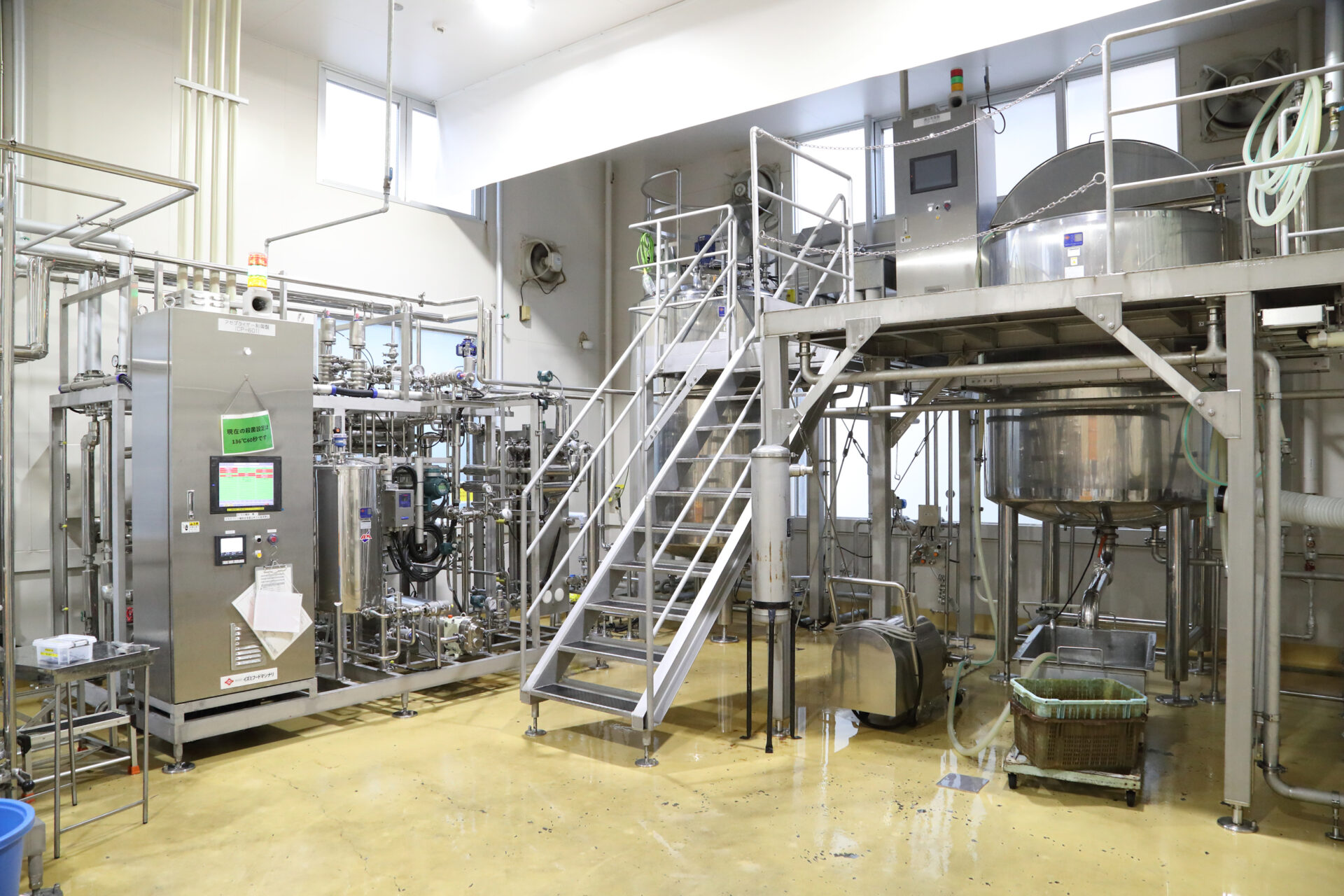
Liquid line (2 rooms in total)
Processing ability
| 1日Possible production volume per day | 1,000kg to 1,400kg |
|---|---|
| Product form | Crimp can, QB tenor, aseptic filling |
| Foreign body removal | strainer |
| Main entry points | 18kg (crimp can), 20kg (QB tenor), 2kg (aseptic filled), 10kg (aseptic filled) |
Products
| Crimp Can | Dashi is extracted from coarsely crushed dried bonito flakes and other ingredients, then hot packed into cans (hot packs), sealed, cooled under running water, and stored in the refrigerator. When in use, you open a hole in the top of the can with a can opener, which allows for efficient extraction of the dashi, making it useful for manufacturers who use large quantities of dashi. Main applications: Food manufacturers (medium to large-scale production lines) |
|---|---|
| QB Tenor | The cardboard box contains a film bag container with a cap, so even if you don’t use up the entire contents, you can store it again. You can also replace the cap with a commercially available nozzle with a cock, allowing you to dispense small amounts at a time. Main applications: Food manufacturers (small to medium-sized lines), restaurants, etc. |
| Aseptic filling | This is a sterile liquid stock made using a dedicated aseptic filling line. Recommended for customers who want to use safe stock above all else. The 2kg type is easy to handle and is convenient when you want to use a small amount for multiple items. If you want a fairly large amount of stock, the 10kg type is good value for money. Once you’ve finished using it, all that’s left is the outer cardboard box and a thin aluminum bag, making waste disposal easy. Main uses: Food manufacturers (small to medium-sized lines), restaurants, etc. |
Oshima Factory
Certifications
- FSSC22000 Certification Audit Registration Scope (dried bonito and mackerel shavings, seasoned bonito shavings, and seasoned dried fish powder)
- Business license: Fishery product manufacturing
- Pet feed manufacturer (dogs/cats)
Seasoning drying line (1 room)
Processing ability
| Possible production volume per day | 1,000kg to 2,000kg |
|---|---|
| Shifter | 6 mesh, 5 mesh, 4 mesh, 3.5 mesh, 3 mesh, 2 mesh |
| Foreign body removal | Magnets, classifiers, X-ray detectors, metal detectors |
| Main entry points | 10kg |
Products
| Furikake | Dried bonito flakes (mainly obi-shaved bonito flakes) are seasoned and mixed with soy sauce and sugar, then slowly dried for about 50 minutes in a large dryer with a total length of 27 meters. Once dried, the dried bonito flakes are passed through a sifter to be sized to your desired size. The crisp, dried flakes are ideal for use as a topping for furikake. Main use: Furikake |
|---|---|
| Seasoned stock raw powder | Dried bonito powder can also be seasoned and dried. The seasoned powder is used in dashi packs. Main use: Dashi packs |
Please feel free to contact us if you have any questions regarding our commercial-use bonito flake products.
OEM product development process at Kobayashi Foods Co., Ltd.
STEP 1: Interview
We listen in detail to your requests, concept, target audience, budget, etc. We utilize our extensive experience and knowledge to propose optimal product specifications. If you already have a recipe, we will use it as a base and match it with the development team to recreate the recipe.
STEP 2: Prototype development
Based on the contents of the interviews, we develop multiple prototypes. We test them from various angles, such as taste, aroma, and texture, and ask customers to evaluate them. For customers who prioritize the speed of new product development, we can accommodate a development system where you can come to our office for a meeting, or our staff will visit you directly, and we can exchange opinions on the spot and create a product together.
STEP 3: Deciding on product specifications
Based on the evaluation results of the prototype, product specifications are determined, including details such as raw materials, composition, manufacturing method, packaging format, and quality standards.
STEP 4: Test manufacturing using actual equipment
We carry out mass production trials using an actual production line. We confirm that stable quality can be ensured and then perform a final quality evaluation. During test production, we also accept customer attendance and pre-audits. By seeing the actual manufacturing site, we can commercialize the product only after you are satisfied with the quality and process.
STEP 5: Full-scale production and delivery
Once a product has passed all evaluations, we begin full-scale production. We deliver products on time under strict quality control.
*Please feel free to contact us regarding small-lot production or short delivery times.
Frequently asked questions
Q. Is small-lot production possible?
A. Yes, it is possible. We offer flexible production options to suit your sales plans, such as test sales or regional sales. Specific lot sizes vary depending on the product specifications, so please feel free to contact us.
Q. Is it possible to develop original recipes?
A.Of course. If you tell us your concept and image, our development team will propose the best recipe. If you have your own original recipe, we can also create a product based on it.
Q. Is there a stable supply of raw materials?
A.We handle over 1,000 tons of dried bonito flakes per year, and have secured a stable supply route for raw materials. We also respond flexibly to fluctuations in raw material prices, ensuring stable quality and supply.
Q. How long does it take from production to delivery?
A. If you order dried bonito flakes, powder, dashi packs, or liquid dashi products, they will be delivered in about two weeks. For seasoned dried products, it will take about two months. However, this will vary depending on the product specifications and production status, so please contact us for specific delivery times.
Please feel free to contact us first
Please feel free to consult us about anything, from the product development idea stage to specific manufacturing conditions. Our expert advisors will support your product development.