
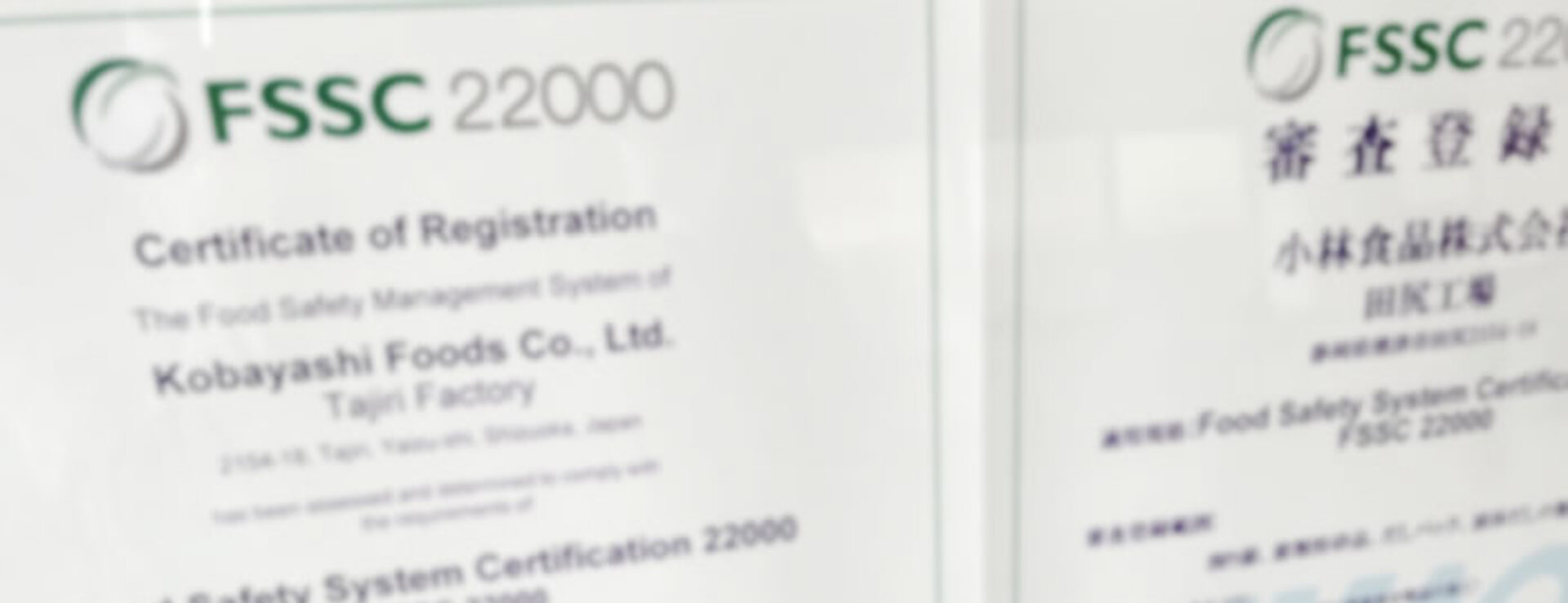
FSSC22000 certified
Kobayashi Foods’ Tajiri and Oshima factories have acquired the international standard FSSC22000. In addition to the HACCP requirements that ensure product safety through process management, FSSC22000 requires the establishment of an organizational management system that enables continuous improvement through the operation of PDCA. Furthermore, a certain level of equipment is required, making this certification an indication that a high level of food safety is being implemented.
Certification details
Tajiri Factory
| Registration Scope | Manufacture of dried bonito flakes, crushed dried bonito flakes, dashi packs, and liquid dashi |
|---|---|
| Date of acquisition | 2018.2.15 |
| Inspection Agency | Japan Management Association |
Oshima Factory
| Registration Scope | Manufacture of dried bonito and mackerel shavings, seasoned bonito shavings, and seasoned fish powder. |
|---|---|
| Date of acquisition | 2019.3.20 |
| Inspection Agency | Japan Management Association |
What is FSSC22000?
FSSC22000 (Food Safety System Certification 22000) is an international standard for food safety management systems (FSMS), which translates to “food safety system certification.” FSSC22000 includes the content of HACCP, and also requires a certain level of facility and hygiene management based on the content of management systems (ISO22000) and individual technical specifications (ISO/TS22002), with additional requirements supplementing the food safety content. This standard requires a high level of food safety initiatives with a wide range of content, and constant improvement as a management system.
FSSC22000 consists of the following three standards:
- ISO22000
- ISO/TS22002 (Prerequisite Programs (PRPs))
- Additional requirements
ISO 22000 is a “food safety management system” consisting of 10 chapters. A management system is a “mechanism,” and its purpose is to build a system for food safety. It involves setting food safety goals for the company, deciding what to do to achieve those goals, and establishing detailed rules for producing safe products on a daily basis, as well as the establishment of a HACCP system. The company is also required to review its past activities and make further improvements. A food safety system based on the PDCA cycle, which involves planning, doing, checking, and acting, is being built.
ISO/TS 22002 includes the contents of prerequisite programs (PRPs). Prerequisite programs are also known as the foundation of food safety, and they describe the standards for facilities and hygiene management. Specifically, they set rules for floor and wall materials, machinery, and building structure to ensure food safety (hygiene) is not threatened. While management systems address soft aspects such as rules and mechanisms, ISO/TS 22002 requires hard aspects such as buildings and equipment, which is costly and is one of the reasons why it is considered a high-hurdle certification. At the same time, achieving the contents of these prerequisite programs is proof that facilities and management standards are above a certain level.
The additional requirements include food safety requirements that could not be fully covered in the above ISO standards.
FSSC 22000 also has unique audit methods, which are basically conducted in the following order: 1) announced audit, 2) unannounced audit, and 3) renewal audit.
| ① Notification examination | Compliance with standards will be reviewed for one year after certification or renewal. |
|---|---|
| ② Unannounced audit | ① This is an audit that is conducted the year after the notification audit, and you do not know when the auditor will come. The audit is conducted to prove that you are in compliance with the standards, regardless of when the auditor will come. |
| ③ Renewal examination | The status of compliance with standards over the three-year period, including the two years prior to the assessment, will be reviewed to confirm whether food safety has been achieved in the medium to long term and whether further improvements are needed. |
Certification is renewed every three years through these audits, encouraging the company to improve and grow, including in food safety.